Blog · October 30, 2026 · 5 min read
Rough pool plaster in Phoenix: why it happens
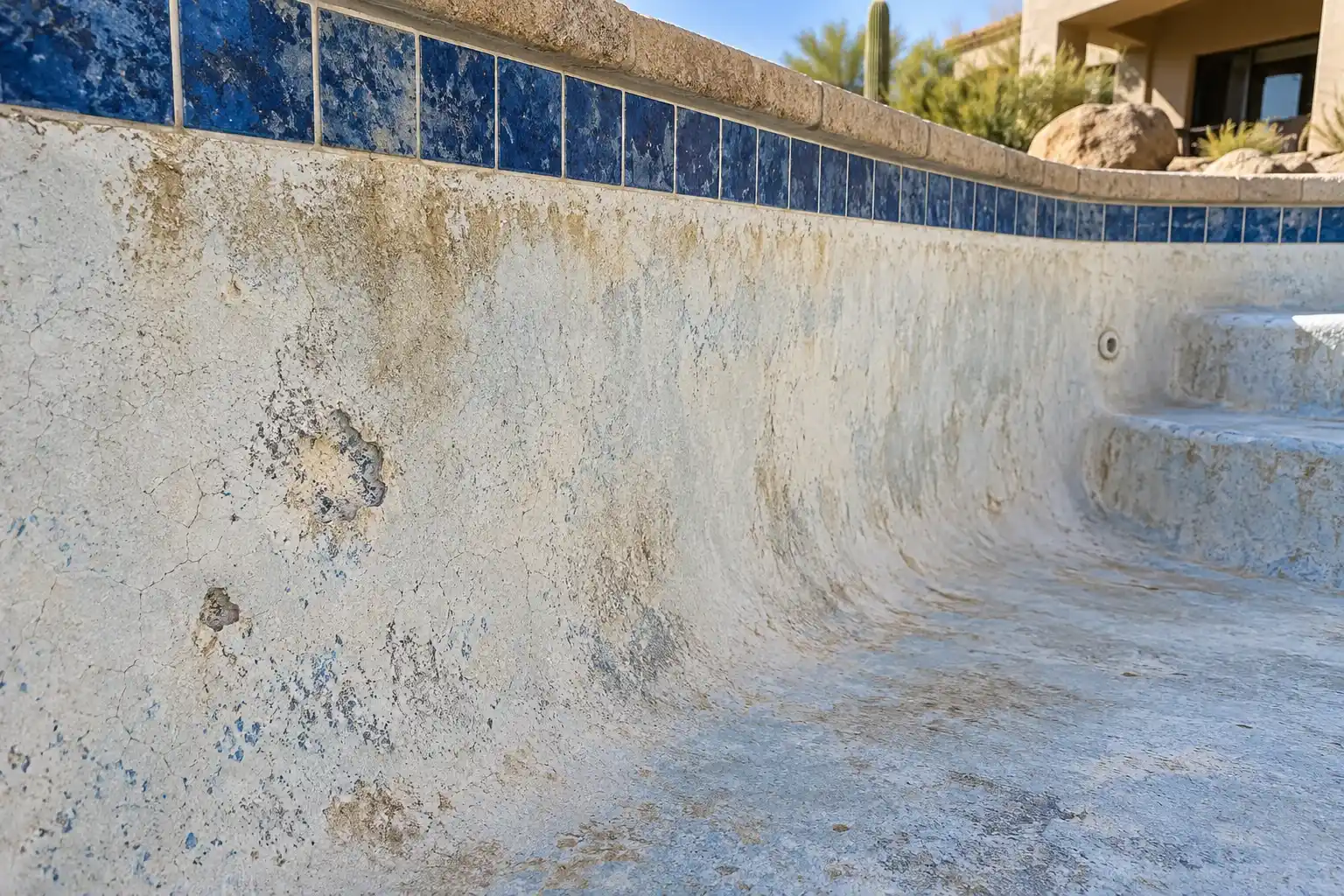
Rough pool plaster in Phoenix tends to trace back to 3 things: hard water that leaves scale, sun and age. Brushing and balanced water can slow the wear for a while, but a surface that stays rough underfoot is likely at the end of its life. Plaster that feels rough, gritty or chalky has a cause, and it helps to know which one you are dealing with. Here is what each one does, what can help for a while and when a new finish is the better call.
All postsSigns
Why does pool plaster turn rough and chalky in Phoenix?
Plaster turns rough in Phoenix when mineral scale builds on it, when water chemistry wears it away or when it simply gets old. A 2026 Arizona pool cost guide says intense UV and hard water make plaster fail faster here than in milder climates.
The county guides we checked do not use the word chalky. They name 2 chemistry problems that roughen plaster, scale and etching, and a surface with either one can end up rough or pitted.
Signs
How does hard water roughen pool plaster?
Hard water carries calcium, and calcium scale is a named cause of rough plaster. Los Angeles County's pool technician guide says high calcium levels may lead to calcium carbonate scale, which results in rough plaster surfaces (LA County Public Health, study guide (opens in a new tab)).
San Bernardino County calls scale white calcium deposits on pool surfaces and says it can point to high pH, high chlorine or high or low calcium hardness.
Phoenix tap water is hard. The City of Phoenix 2025 Water Quality Report (opens in a new tab) lists total hardness at 172 to 302 ppm (10 to 17.6 grains per gallon) and says hard water can cause some types of scaling in pipes, water heaters and plumbing fixtures. That report covers drinking water, not pool chemistry, so only a test of your own pool water shows how much calcium it holds.
Plaster
What do sun and age do to pool plaster?
Plaster has a working life, and sun and hard water can push it toward the short end of the range. A 2026 Arizona pool cost guide puts standard plaster at a 10 to 15 year life here, and a national 2026 cost guide puts it at about 10 years and says water chemistry affects how long it lasts.
Water that is too soft for plaster does damage from the other direction. Los Angeles County says low calcium levels can result in etching and pitting of plaster. San Bernardino County says water low in calcium pulls it from whatever source it can reach, usually the plaster coat, and it names neglected calcium levels as the top cause of plaster failure and early resurfacing (San Bernardino County, Operational Guide (opens in a new tab)).
Los Angeles County adds that low calcium is usually not a problem on the west coast, where hard water is the norm. Phoenix tap water is also hard, but your pool's own test result decides which problem you have.
Signs
What helps rough pool plaster for a while?
A water test comes first, because the right move depends on the cause. After that, a few habits can slow the wear:
- Test the water. Los Angeles County's guide keeps calcium hardness between 175 and 300 ppm and total alkalinity between 80 and 150 ppm in plaster pools. Those are Los Angeles County targets for pool service workers, so treat them as a reference for a water test, not a recipe.
- Keep pH and alkalinity in range. San Bernardino County says proper pH and total alkalinity help prevent scale formation.
- Brush. A rough surface gives algae a place to hold. Los Angeles County lists rough finishes and scale among the conditions that encourage algae, and it says to eliminate algae by brushing the walls and floor.
- Ask about a partial drain and refill if the water is the problem. Los Angeles County names that fix for high calcium. Draining a pool in Phoenix shows where the water may go.
Whether an acid wash fits your pool depends on the scope, so ask us rather than assume. Fixing the water addresses the cause going forward, and it does not make a worn surface new.
Signs
When does rough plaster mean the finish is done?
Rough plaster likely means the finish is done when the roughness stays after brushing and balanced water, and it comes with other signs. These are the ones to watch:
- Bare feet find a rough or grainy surface that used to be smooth.
- White scale rings the waterline and will not scrub off.
- Stains have settled in and will not brush out.
- Patches have thinned and the gray shell shows through.
- Small cracks or hollow spots have appeared where the plaster let go of the shell.
- The finish is 10 years old or older, around the point where Arizona plaster commonly nears the end of its 10 to 15 year range.
Seeing 2 or more of these may mean it is time. The pool plastering page goes through the signs and the process.
The next finish can be plaster, quartz or a pebble style. A 2026 Arizona pool cost guide puts plaster at $6,000 to $10,000 per pool and pebble style at $9,000 to $16,000, and plaster, quartz or pebble sets the 3 side by side. The resurface itself takes about 5 to 7 days according to national 2026 cost data, covered in how long pool resurfacing takes.
We serve Phoenix and the towns around it. Tell us what your pool surface feels like, and someone from our team will call you back. We go over the finish, the budget and the timing with you.
4 questions
Questions people ask
Still have a question? Call (747) 243-2089 and say what your pool is doing.
Can hard water make pool plaster rough?
Calcium scale can leave plaster rough, according to Los Angeles County's pool technician guide. Phoenix tap water measured 172 to 302 ppm total hardness in the City of Phoenix 2025 report. A water test of your own pool shows whether calcium is high enough to matter.
Is rough plaster a sign the pool needs resurfacing?
Not always, because rough texture has more than 1 cause, and scale and etching are 2 of them. When it stays rough after brushing and balanced water, or comes with stains, thin patches that show the shell or cracks, the finish is likely at the end of its life.
How long does pool plaster last in Phoenix?
About 10 to 15 years, according to a 2026 Arizona pool cost guide, which says intense UV and hard water make plaster fail faster here than in milder climates. A national 2026 cost guide gives plaster about 10 years. How long a pool surface lasts in Phoenix covers each finish.
What does it cost to redo rough plaster in Phoenix?
A 2026 Arizona pool cost guide puts a plaster resurface at $6,000 to $10,000 per pool, and a pebble style finish at $9,000 to $16,000. Pool size, the finish and the prep decide where yours lands. The pool cost estimator builds a range from your own pool.
Keep reading